About V-LiSEMOD
0
Core modules
0
PROTACability evidence layers
0
Companion design tools
Viral structures, ligand exposure, and degrader-readiness evidence in one workspace.
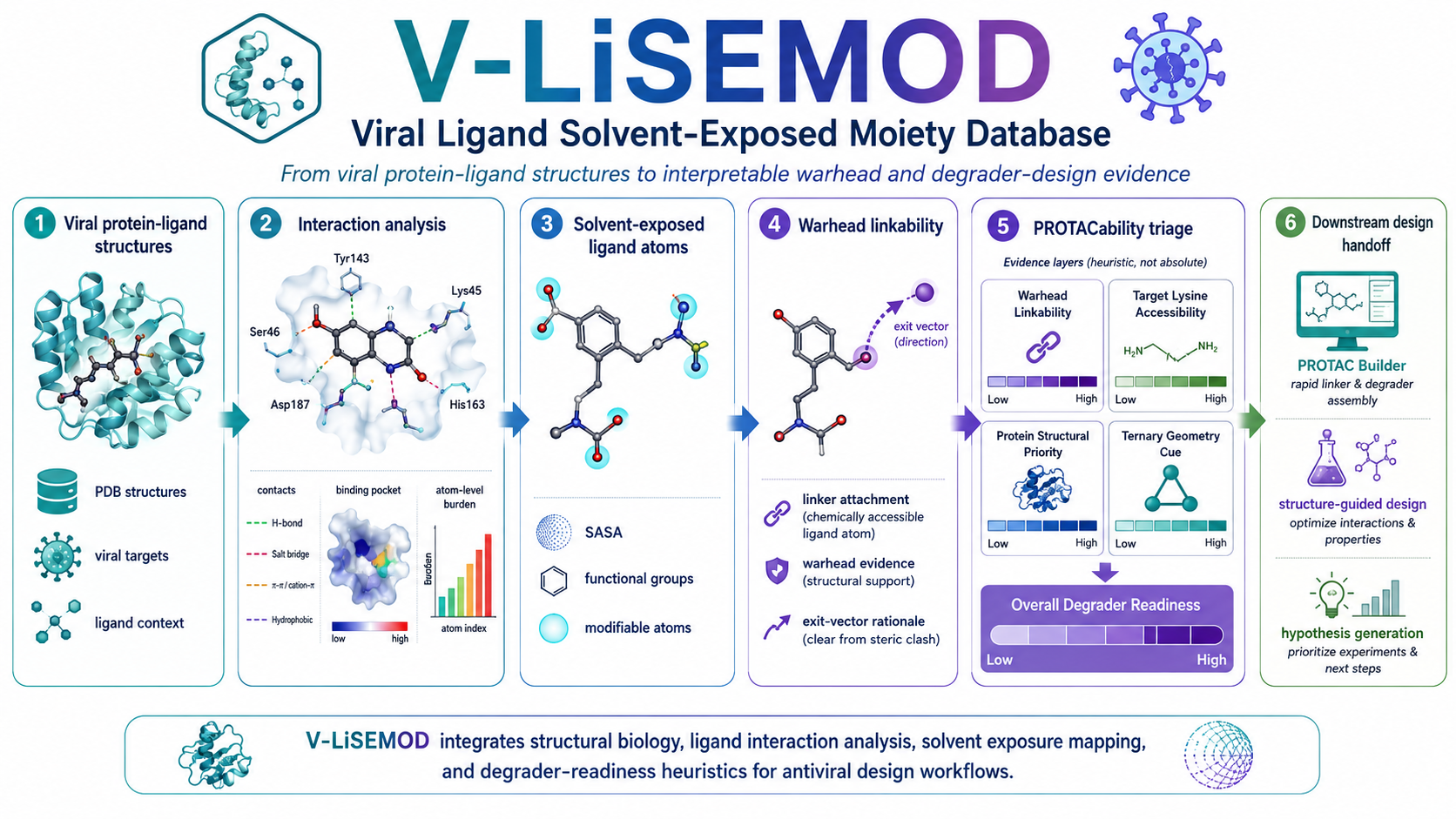
V-LiSEMOD helps researchers move from viral protein-ligand co-crystal structures to interpretable ligand interaction evidence, solvent-exposed moiety analysis, warhead/linkability review, and PROTACability-style triage.
Scientific purpose
Why this project exists
Viral drug discovery needs tools that keep protein-ligand structure, interaction evidence, solvent exposure, and modification logic close together.
Many viral inhibitors are structurally characterized, but the information needed to reason about chemical modification is often fragmented across PDB files, ligand identifiers, interaction outputs, solvent accessibility calculations, and custom downstream scripts.
V-LiSEMOD organizes those evidence layers into a public-access web platform so researchers can ask structure-aware questions before moving into medicinal chemistry, linker design, or downstream degrader modeling.
Origin and foundation
From antiviral degrader concepts to linkable ligand analysis
V-LiSEMOD grew from the repeated need to inspect viral inhibitor co-crystal structures for exposed, chemically useful ligand positions.
The project was motivated in part by the structure-guided questions raised during work on Targeted degrader technologies as prospective SARS-CoV-2 therapies in Drug Discovery Today. That review considered how known viral inhibitor structures, including SARS-CoV-2 3CLpro inhibitor complexes, could inform targeted protein degradation strategies.
A key lesson was that a binder is not automatically a useful warhead. Researchers need to ask whether the bound ligand presents solvent-accessible atoms, plausible linker attachment vectors, preserved interaction context, and a protein environment worth deeper degrader-oriented review.
Related publication
Targeted degrader technologies as prospective SARS-CoV-2 therapies
Khurshid, Schulz, Hu, Snowden, Reynolds, and Schürer. Drug Discovery Today, 2024.
Interactive workflow
How V-LiSEMOD moves from structure to design evidence
Select a step below to see how the platform transforms viral structural data into interpretable ligand modification and degrader-readiness evidence.
Step 01
Viral protein-ligand structures
Begin from curated viral protein-ligand structures organized by virus, PDB ID, ligand, chain, and residue context.
- Search viral targets and protein classes.
- Select ligand-bound structural contexts.
- Keep chain and residue identity visible for interpretation.
Platform modules
What V-LiSEMOD does
The app supports structure-first, target-first, and ligand-first ways to explore viral protein-ligand evidence.
Curated viral structure exploration
Select virus, PDB structure, ligand, chain, and residue context from the curated workspace.
Open explorer →Target-centric search and export
Filter viral structures by target and ligand context, then assemble export-ready datasets.
Open Protein Query →Ligand-first lookup
Start with a ligand code or synonym and find mapped PDB-chain-residue contexts.
Open Ligand Indexer →Cross-structure ligand comparison
Compare interaction fingerprints, distance profiles, and atom-level burden across structures.
Compare ligands →Solvent-exposed moiety analysis
Use SASA and atom annotations to reason about exposed, potentially modifiable ligand positions.
View workflow →Warhead and linker-vector reasoning
Move promising ligand contexts into downstream degrader design tools when the evidence supports review.
Open PROTAC Builder ↗
PROTACability
Transparent degrader-readiness triage
PROTACability in V-LiSEMOD is a structure-guided prioritization framework, not an experimental degradation prediction.
Interpretation guardrail:
PROTACability outputs are structural-priority and design-readiness heuristics. They support hypothesis
generation and triage, but they are not experimentally validated degradation predictions.
Warhead Linkability
Evaluates whether a bound ligand contains solvent-exposed, chemically interpretable atoms that may tolerate linker attachment while preserving key interaction context.
Connected ecosystem
A modular workflow for induced-proximity design
V-LiSEMOD sits upstream of companion tools for warhead analysis, E3 recruiter review, and degrader construction.
Warhead Hunter
Structure-aware solvent exposure and exit-vector analysis for bound ligands.
Open Warhead Hunter ↗E3 Ligandalyzer
E3 ligase recruiter structure analytics, scaffold context, and attachment-vector review.
Open E3 Ligandalyzer ↗PROTAC Builder
Downstream linker, recruiter, and warhead assembly for PROTAC-like molecule design.
Open PROTAC Builder ↗
Responsible use
Interpretation and limitations
V-LiSEMOD is best used for structure-guided review, ligand interaction analysis, solvent-exposed atom discovery, and transparent prioritization before deeper computational or experimental work.
It does not prove degradation, guarantee ternary complex formation, replace SAR, or validate that a ligand can become a successful warhead. Experimental and medicinal chemistry review remain essential.
Treat charts, exposure maps, PyMOL outputs, and PROTACability tables as evidence layers for hypothesis generation. Review structure quality, ligand chemistry, interaction context, and downstream feasibility before making design decisions.
Project resources
Explore V-LiSEMOD topics
Explore deeper background on viral PROTAC design, structure-guided antiviral discovery, computational methods, citation guidance, and collaboration opportunities.
Contact
Contact and collaboration
Reach out about viral drug discovery, targeted protein degradation, dataset expansion, and scientific software collaboration.
Read more → Use CasesHow different researchers use V-LiSEMOD
See target exploration, solvent-exposed atom review, ligand comparison, PyMOL generation, and teaching workflows.
Read more → Degrader ConceptsViral PROTAC design
Learn why viral binders are not automatically degrader warheads and how structural triage can guide follow-up review.
Read more → TargetsViral drug targets
Explore the structural logic behind proteases, polymerases, reverse transcriptase, integrase, and other viral target classes.
Read more → Computational ToolsIn silico virology tools
Look at V-LiSEMOD within a broader structure-guided antiviral and degrader-design computational workflow.
Read more → MethodsMethods overview
Read a high-level summary of curation, interaction analysis, solvent exposure mapping, PyMOL outputs, and evidence layers.
Read more → FAQFrequently asked questions
Get concise answers about solvent-exposed moieties, warhead linkability, PROTACability, exports, and project scope.
Read more → CitationCitation and attribution
Find project citation language, publication context, and attribution guidance for presentations and manuscripts.
Read more →
Start exploring
Use V-LiSEMOD to turn viral structural data into design-ready evidence.
Begin with a target, a ligand, or a structure, then move toward interaction review, solvent-exposed atom analysis, and degrader-readiness triage.