Structure-guided interpretation
Translate co-crystal structures and ligand poses into practical design questions rather than isolated snapshots.
V-LiSEMOD is a research and software project focused on viral protein-ligand analysis, solvent-exposed atom review, warhead and linkability assessment, PyMOL session generation, and PROTACability-style structural triage. This page is designed for researchers, software collaborators, and scientific partners who want to explore joint work at the intersection of structural biology, medicinal chemistry, cheminformatics, and degrader-oriented antiviral design.
If you are exploring viral drug discovery, structure-guided design, dataset curation, or antiviral degrader concepts, V-LiSEMOD can serve as a practical hub for early structural review, collaboration planning, and hypothesis generation.
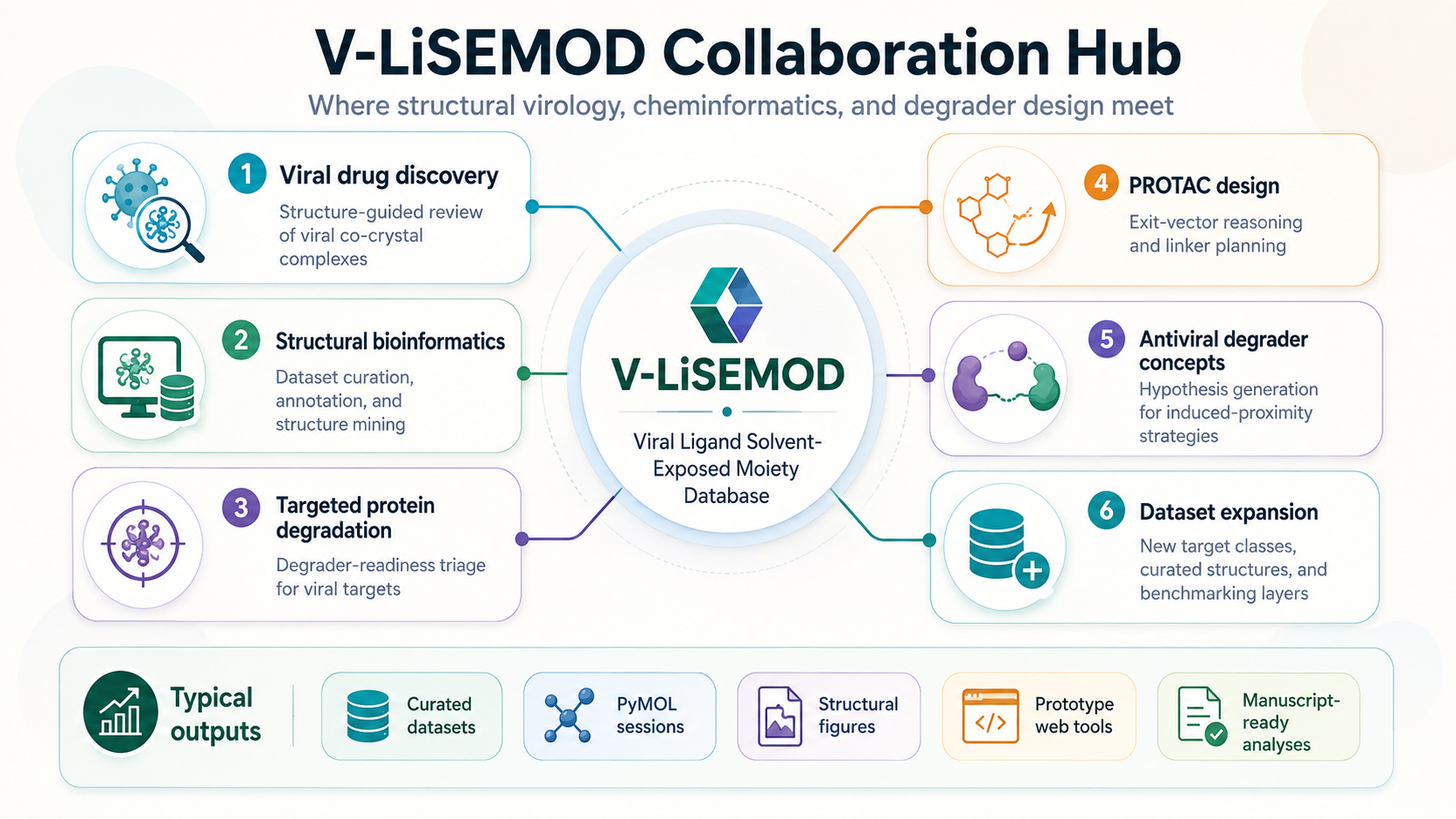
V-LiSEMOD is built around a simple idea: high-value structural resources become more useful when they are interpretable, reproducible, and easy to connect to real research decisions. Rather than acting as a black-box prediction layer, the platform is designed to help users inspect ligand binding context, solvent-exposed atoms, exit-vector logic, ligand series relationships, and protein-side structural cues in a way that can directly support scientific discussion.
That makes V-LiSEMOD a strong fit for academic collaborations, pilot studies, benchmarking projects, translational discussions, tool-building partnerships, and manuscript-oriented research efforts. It is also a useful framework for researchers who need to move from a single co-crystal structure toward a broader, more systematic antiviral design conversation.
Translate co-crystal structures and ligand poses into practical design questions rather than isolated snapshots.
Keep decision-making interpretable by connecting each design idea back to visible structural evidence.
Support collaborations spanning structural biology, medicinal chemistry, virology, cheminformatics, and software development.
Generate figures, annotations, prototype workflows, dataset layers, and manuscript-ready analyses from the same foundation.
The project emphasizes careful scientific interpretation, realistic structure-guided reasoning, and useful handoff into downstream analysis. These are some of the most natural collaboration areas for V-LiSEMOD.
Structure-guided review of viral co-crystal complexes, ligand series, and tractable target classes for follow-up analysis.
Dataset curation, structure mining, annotation workflows, and methods development around viral protein-ligand complexes.
Hypothesis-generating degrader-readiness triage for viral targets, including warhead context and lysine accessibility review.
Early-stage exit-vector reasoning, linker attachment questions, and handoff into downstream degrader design workflows.
Exploratory design discussions for induced-proximity strategies against viral proteins and viral-host interfaces.
New viral target classes, additional curated structures, annotation coverage, and benchmarking-ready public data layers.
Joint work on scientific communication, reproducible methods, companion tools, and web platform integration.
Bridge V-LiSEMOD outputs into related resources such as warhead discovery, E3 recruiter review, and downstream builder tools.
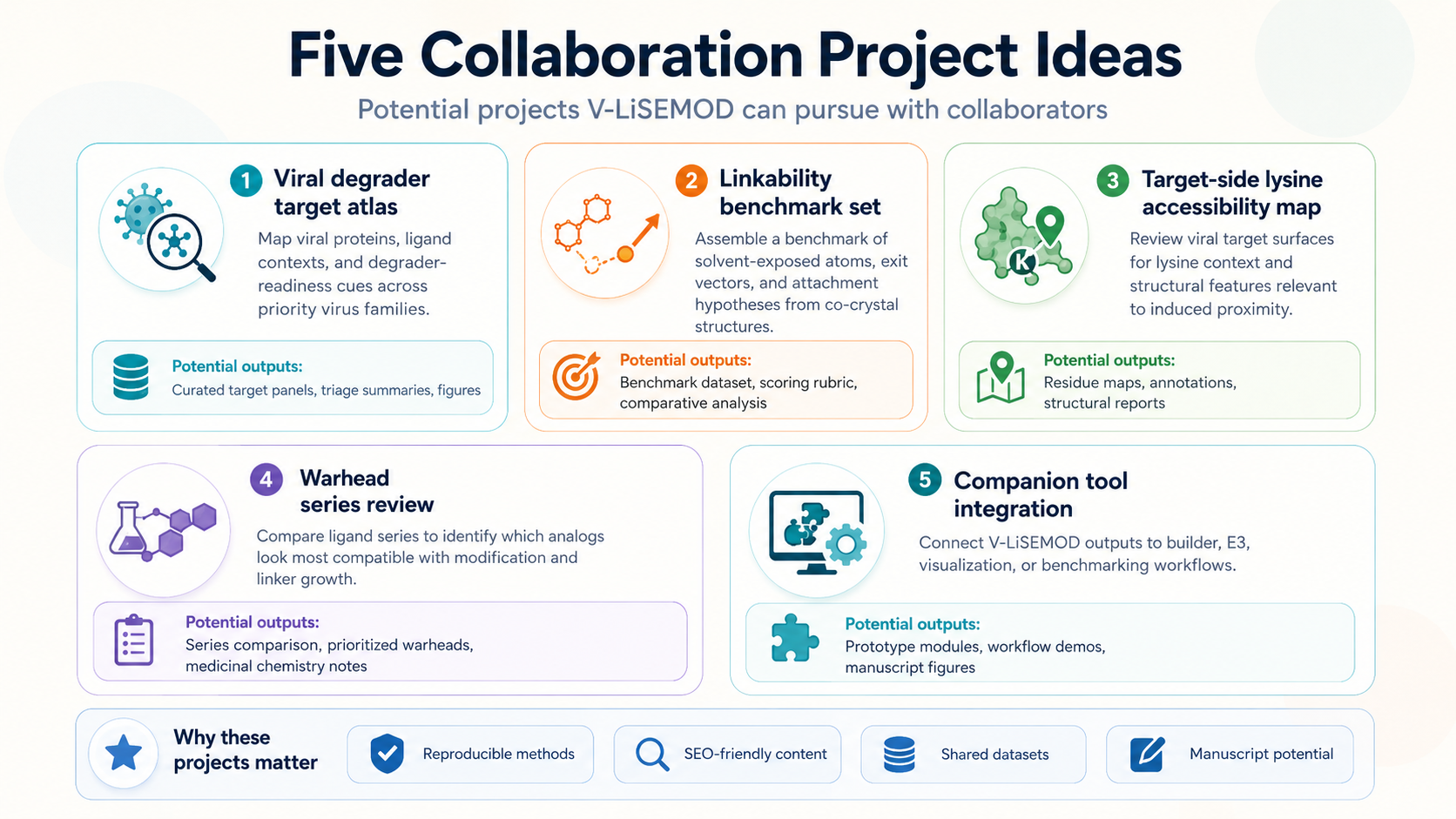
To make collaboration more concrete, here are five example project directions that are well aligned with the current platform. Each one creates value for science, improves the visibility and usefulness of the resource, and can generate high-quality figures, datasets, and method narratives for broader dissemination.
Build a structured atlas of viral proteins, ligand contexts, and degrader-readiness cues across priority virus families. This could help partners compare which viral targets look most promising for future induced-proximity strategies.
Assemble a benchmark dataset of solvent-exposed atoms, exit-vector hypotheses, and attachment ideas drawn from viral co-crystal structures. This would create a useful reference layer for comparison across targets, ligands, and methods.
Review viral target surfaces for lysine context, local topology, and structural features that may be relevant when discussing targeted protein degradation. The goal would be to create a careful evidence layer rather than overclaiming degradability.
Compare ligand series or analog families to identify which compounds appear most compatible with chemical modification, linker growth, and preservation of target engagement. This is especially useful when there are multiple related binders for the same target.
Connect V-LiSEMOD outputs to adjacent tools such as Warhead Hunter, E3 Ligandalyzer, or PROTAC Builder, creating a more continuous workflow from structural triage into broader degrader design analysis.
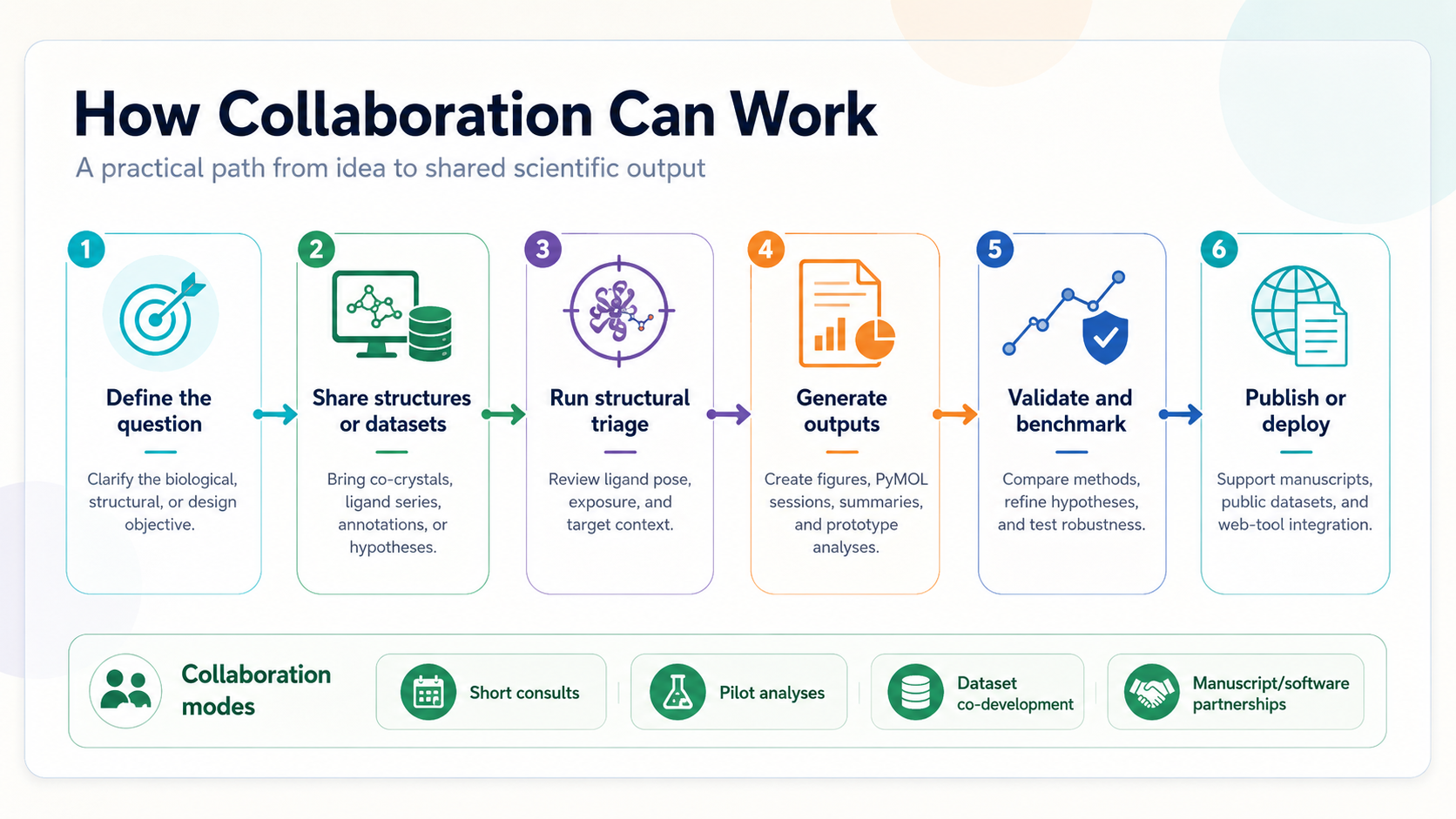
Not every collaboration needs to begin as a large formal project. Many useful collaborations begin with a specific question, a defined structure set, and a targeted deliverable such as a figure panel, a curated dataset, or a prototype workflow.
Clarify the biological, structural, or design objective you want to address.
Provide co-crystals, ligand series, annotations, benchmark ideas, or draft hypotheses.
Review binding pose, solvent exposure, exit-vector logic, and target-side context.
Create figures, PyMOL sessions, comparative summaries, and prototype analysis layers.
Refine the approach, compare alternatives, and evaluate robustness where possible.
Support manuscripts, public data layers, companion tools, or broader scientific release.
If you want to begin a conversation, the most helpful first message is a concise project note. A short message can go a long way if it describes the target question clearly and explains what kind of collaboration or output would be most useful.
If you are using V-LiSEMOD in a manuscript, methods document, poster, or presentation, it is helpful to describe the platform as a structure-guided viral ligand analysis resource with solvent-exposed atom review, ligand comparison, PyMOL session generation, and PROTACability-style structural triage features.
V-LiSEMOD can naturally sit beside companion resources such as Warhead Hunter, E3 Ligandalyzer, and PROTAC Builder, allowing collaborators to move from structural observation into more targeted degrader design conversations.
Depending on the collaboration, outputs may include curated tables, annotated structure sets, custom figure panels, prototype analysis pages, reproducible workflows, and manuscript-ready summaries.
No. A collaboration can start with a small structure review, a dataset question, or a single ligand series that needs interpretation.
No. The platform is broader than degrader design and is also relevant for viral drug discovery, structural annotation, ligand comparison, and visualization workflows.
Yes. The workflow is well suited to figure generation, structured methods descriptions, curated datasets, and analysis-oriented manuscript collaboration.
Absolutely. V-LiSEMOD is a good fit for dataset expansion, benchmark creation, prototype tools, and companion web workflow development.
For collaboration questions, citation support, platform feedback, or research discussions related to V-LiSEMOD, start with a short message describing the project, target, dataset, or scientific question you want to explore. A clear starting note makes it much easier to identify the best collaboration path.
Choose a virus, structure, and ligand to create a PyMOL session or inspect ligand-focused visuals.
V-LiSEMOD is working
Preparing your 2D ligand imagery and structural annotations. While you wait, explore more Schürer Lab tools.
Explore Python-powered molecular visualization workflows and PyMOL integrations.
Visit pymacs.com ↗Review the source, documentation, and installation guidance for the Schürer Lab project.
Open schurerlab/Pymacs ↗Plan docking workflows with the widely used molecular-docking platform.
Visit autodockvina.com ↗Move selected ligands into an interactive PROTAC design workflow.
Visit protacbuilder.com ↗Find and review warhead-focused opportunities for targeted protein degradation.
Visit warheadhunter.com ↗Explore E3-ligase and ligand context for degrader design decisions.
Visit e3ligandalyzer.com ↗