Antiviral target exploration
Browse viral protein targets and inspect which co-crystal ligands are already available for structure-guided follow-up.
V-LiSEMOD supports several entry points into viral structure-guided discovery, from target-centric browsing to ligand-first review and degrader-oriented structural triage. Researchers can use the platform to move from a viral target, ligand, or structural question toward clearer evidence, interpretable design logic, and review-ready outputs.
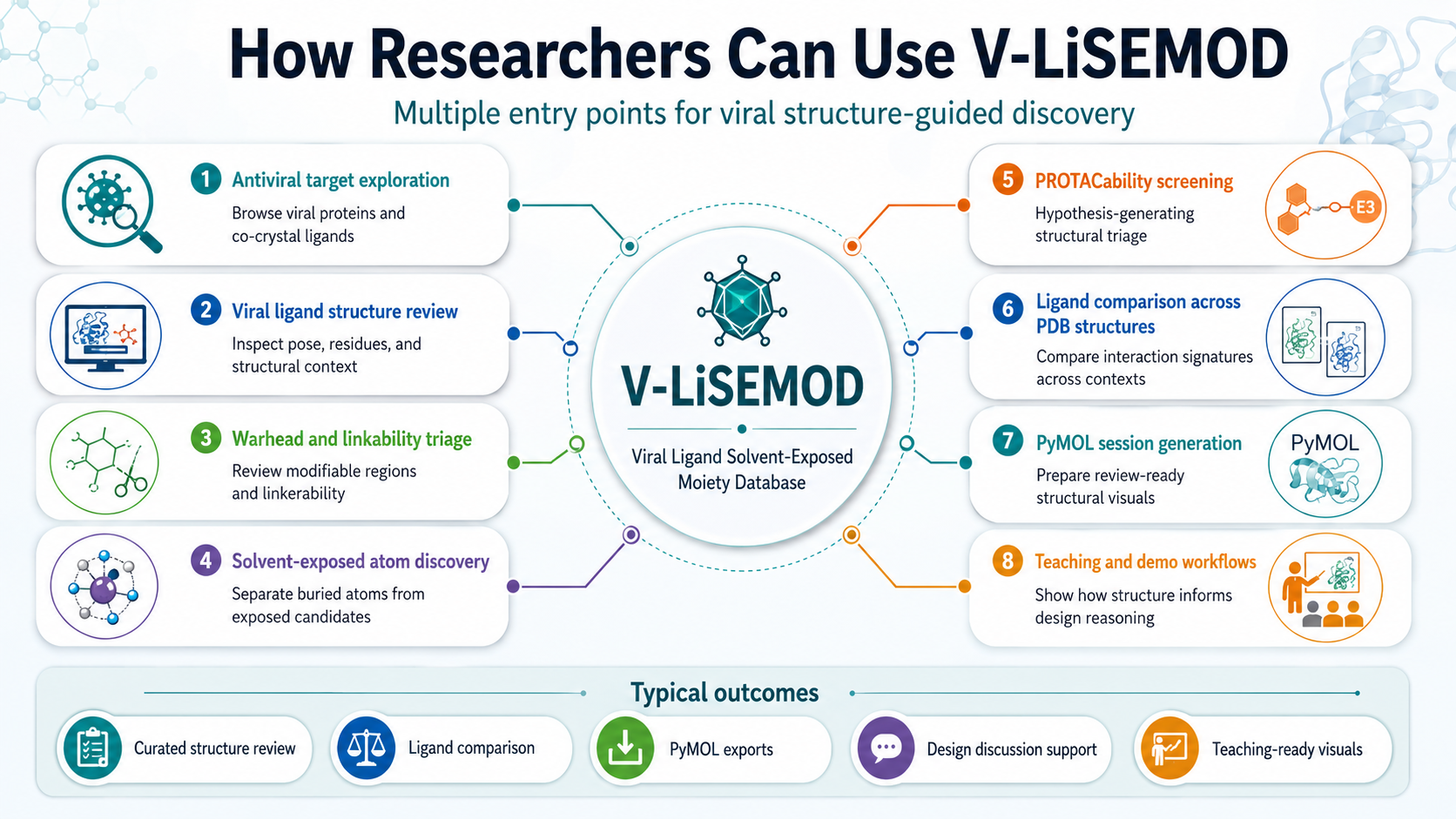
These use cases help turn structural data into clearer design discussions, comparison exercises, and review-ready outputs.
Browse viral protein targets and inspect which co-crystal ligands are already available for structure-guided follow-up.
Examine binding context, ligand identity, residue environment, and structure-specific evidence before drawing design conclusions.
Review whether a known viral ligand presents chemically interpretable, solvent-facing positions that may merit linker-attachment discussion.
Use solvent accessibility and atom-level annotation to separate buried binding atoms from more permissive attachment-vector candidates.
Use the structural evidence layers as a hypothesis-generating triage system rather than a validated degradation predictor.
Compare how related ligands behave in different binding contexts and inspect interaction burden across structures.
Create visual review packages for team discussion, figure preparation, or medicinal chemistry handoff.
Show students or collaborators how structural data informs ligand optimization, solvent exposure reasoning, and careful degrader design triage.
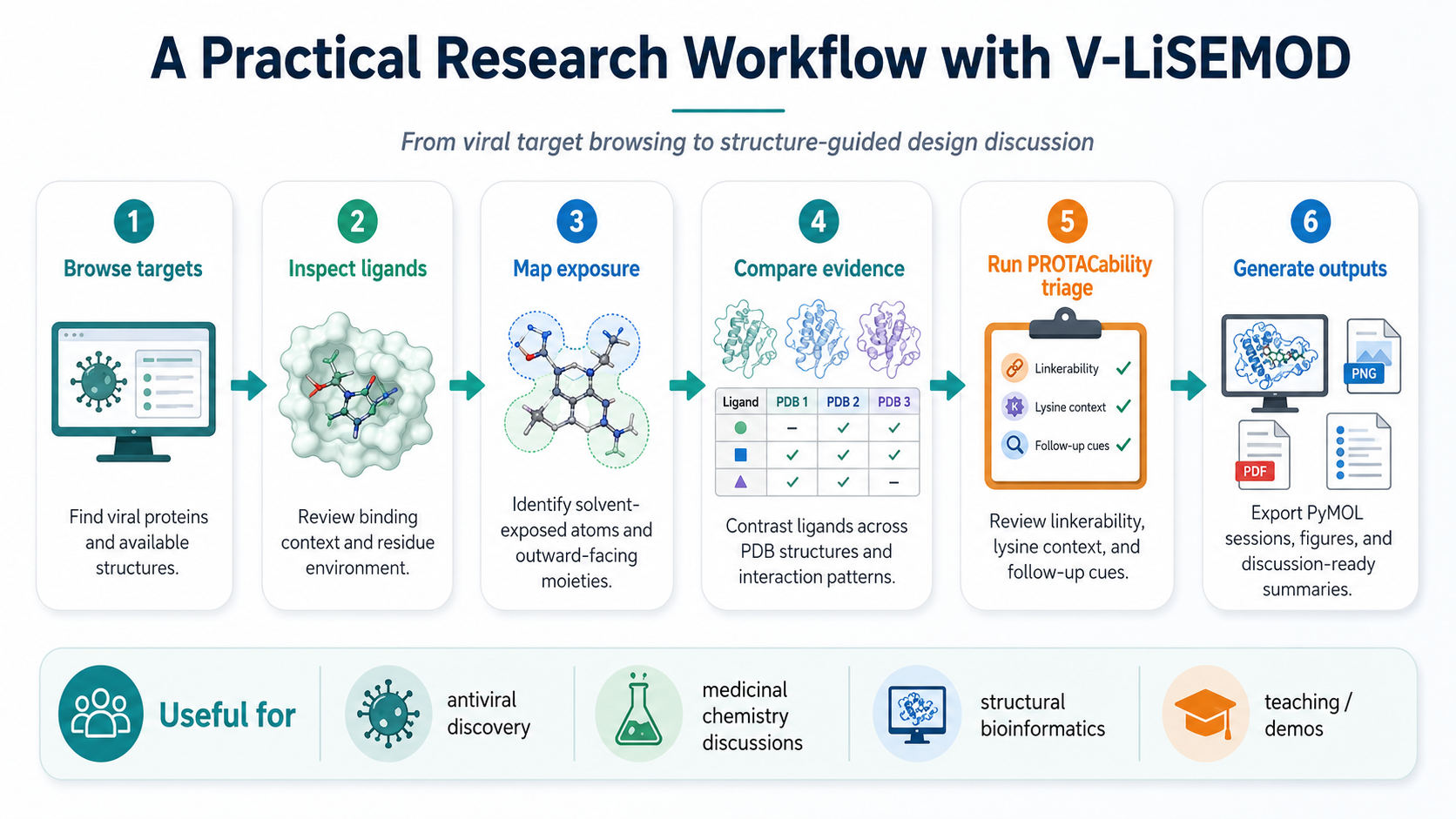
V-LiSEMOD is flexible. Start with the tool that matches the question you are trying to answer.
Open the main workspace and build a PyMOL-ready structure review session.
Open Structure Explorer →Search viral proteins, inspect structure coverage, and export target-focused results.
Open Protein Query →Review interaction signatures and cross-structure behavior for viral ligands.
Open Ligand Comparison →Inspect structural triage evidence for linkerability, lysine context, and follow-up prioritization.
Open PROTACability →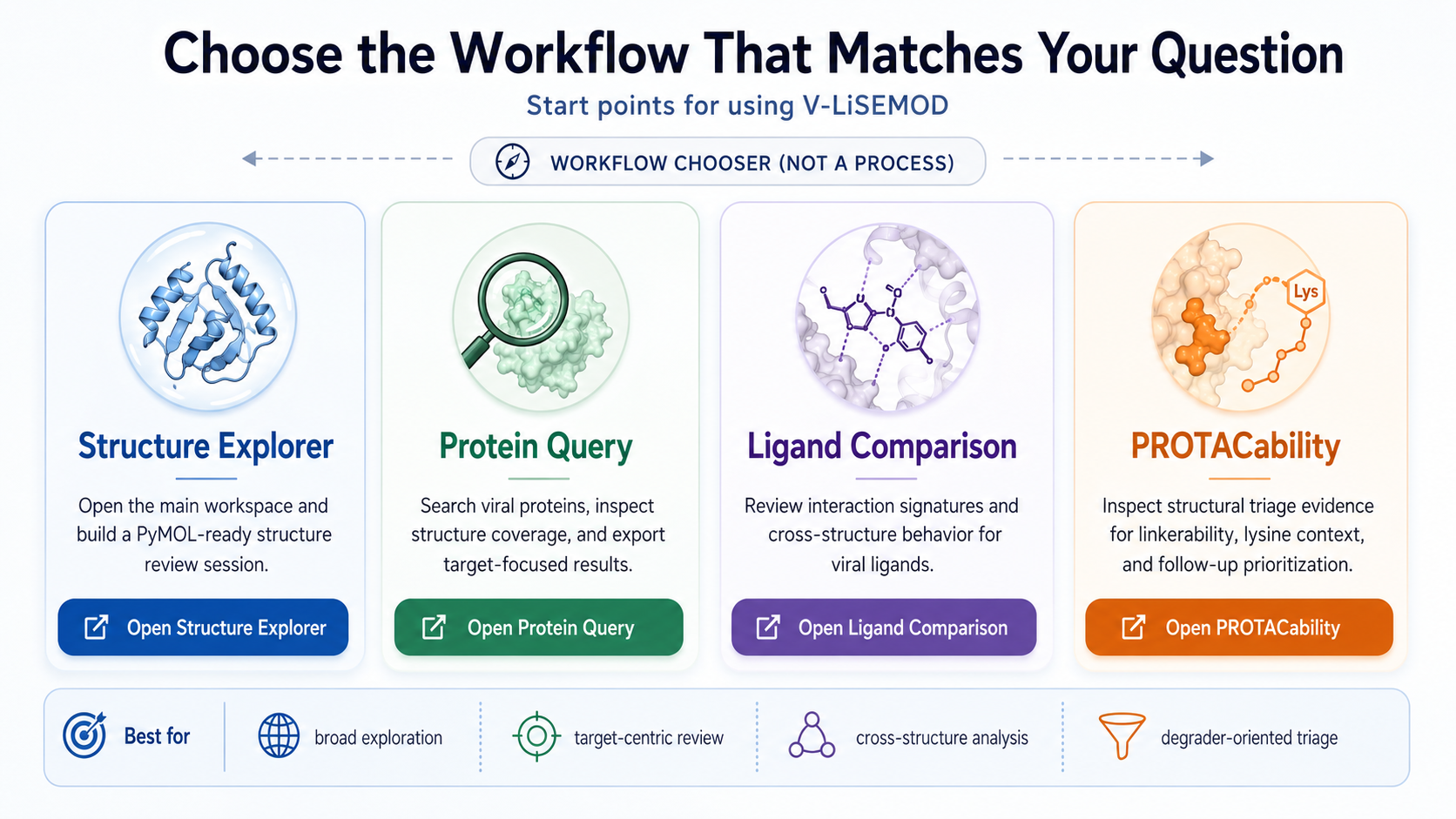
Organize target, ligand, and residue evidence into a more structured review process.
Contrast interaction patterns, context dependence, and structure-specific behavior across related ligands.
Generate visual review assets that can be shared with collaborators, students, or medicinal chemistry teams.
Use structure-backed cues to frame follow-up questions around exposure, linkerability, and target-side context.
Support demos and learning workflows that show how structural evidence guides chemical reasoning.
Help users choose the right entry point before they spend time on a deeper structural or design workflow.
V-LiSEMOD works best as an interpretable, structure-guided workspace. Start with the entry point that best matches your current question, then use the outputs to support follow-up discussion, comparison, and design thinking.
Choose a virus, structure, and ligand to create a PyMOL session or inspect ligand-focused visuals.
V-LiSEMOD is working
Preparing your 2D ligand imagery and structural annotations. While you wait, explore more Schürer Lab tools.
Explore Python-powered molecular visualization workflows and PyMOL integrations.
Visit pymacs.com ↗Review the source, documentation, and installation guidance for the Schürer Lab project.
Open schurerlab/Pymacs ↗Plan docking workflows with the widely used molecular-docking platform.
Visit autodockvina.com ↗Move selected ligands into an interactive PROTAC design workflow.
Visit protacbuilder.com ↗Find and review warhead-focused opportunities for targeted protein degradation.
Visit warheadhunter.com ↗Explore E3-ligase and ligand context for degrader design decisions.
Visit e3ligandalyzer.com ↗